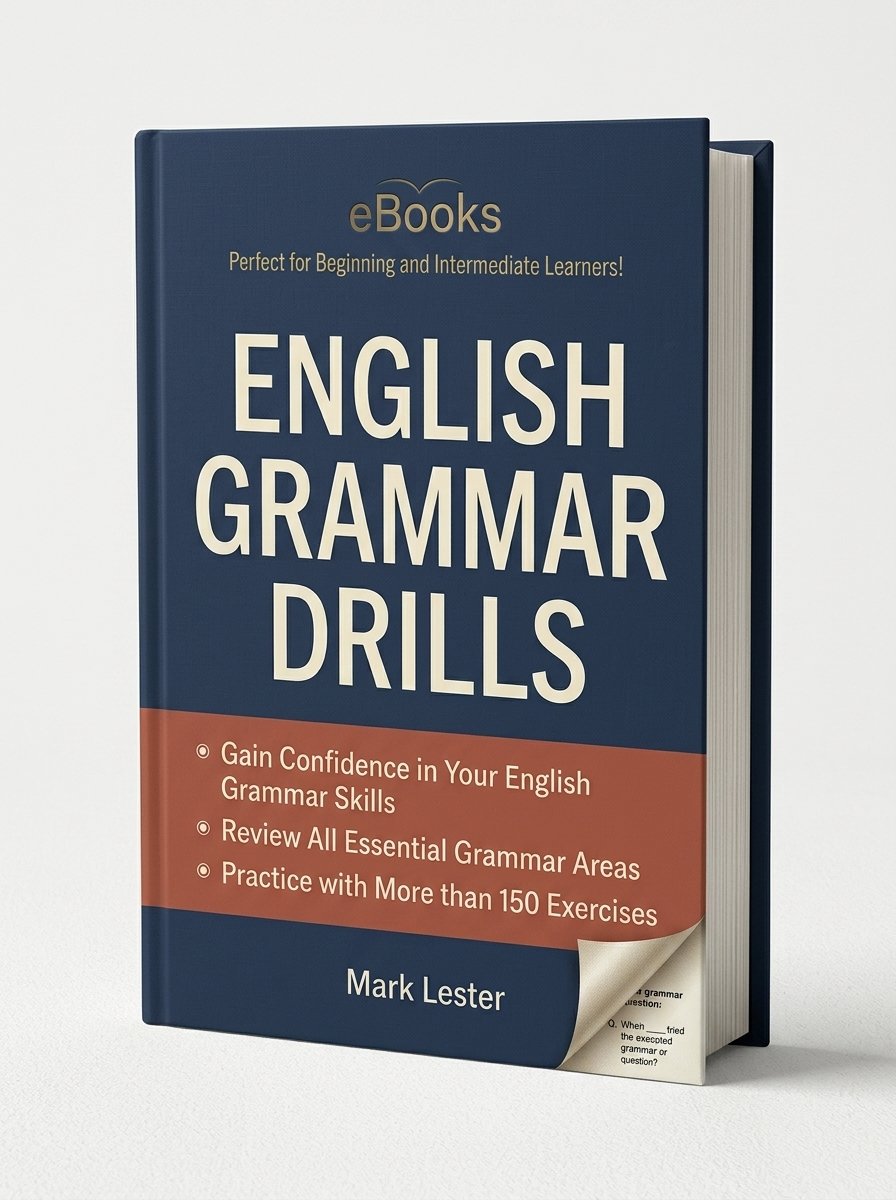
Master the rules of clear communication with English Grammar Drills. This practical resource transforms complex grammar concepts into repeatable, hands-on exercises. Unlike passive reading, active drilling locks correct sentence structures into long-term memory. Ideal for students, professionals, and ESL learners, this method targets common errors in verbs, punctuation, and syntax. Below, we explore five powerful ways drills build lasting grammar fluency.
1. Reinforce Verb Tenses Through Repetition
English Grammar Drills targets the most confusing area: verb tenses. Each drill presents mixed exercises on past, present, future, and perfect tenses. Instead of memorizing rules, you repeatedly choose the correct form: “I have lived here for ten years” vs. “I lived here ten years ago.” This active recall builds automaticity. Within two weeks of daily drills, your brain stops hesitating. You write and speak with natural accuracy. Errors in conditional sentences and irregular verbs drop sharply. Repetition, not explanation, creates fluency.
2. Eliminate Subject-Verb Agreement Mistakes
Nothing signals poor grammar faster than agreement errors. English Grammar Drills offers targeted exercises on singular/plural mismatches, collective nouns, and indefinite pronouns. Example: “The team are playing well” (British) vs. “The team is playing well” (American). Drills force you to spot the subject before choosing the verb. Over time, you internalize tricky cases like “everyone is” and “neither…nor takes singular.” This practice is invaluable for SAT, TOEFL, and business writing. Clean agreement makes your communication credible, polished, and immediately trustworthy.
3. Master Punctuation for Clearer Writing
Commas, semicolons, and apostrophes cause daily confusion. English Grammar Drills breaks punctuation into isolated skill sets. One drill focuses on comma splices: “It’s raining, I need an umbrella” (wrong) vs. “It’s raining; I need an umbrella” (correct). Another drill targets possessive apostrophes versus plurals. By writing corrected sentences repeatedly, you rewire old habits. Within a month, you will confidently use semicolons, colons, and dashes. Proper punctuation eliminates ambiguity, raises essay scores, and prevents embarrassing professional errors. Each drill takes under ten minutes.
4. Fix Pronoun Case and Reference Errors
Who vs. whom? Me vs. I? English Grammar Drills provides systematic practice on pronoun case (subjective, objective, possessive) and unclear references. Example drills ask: “Between you and me (not I)” and “When Maria called Sarah, she was busy” (unclear—fix it). Repetition builds instinct for correct choices. You also learn to spot vague pronouns that confuse readers. This skill is critical for legal, academic, and technical writing. After completing the pronoun unit, your sentences become sharper, fairer, and impossible to misinterpret. Grammar drills turn rules into reflexes.
5. Build Sentence Combining and Parallel Structure
Finally, English Grammar Drills teaches advanced fluency through sentence combining and parallel structure. Instead of short, choppy sentences, you learn to use coordination and subordination. Example: Combine “He likes running. He likes swimming. He dislikes biking.” into “He likes running and swimming but dislikes biking.” Parallel structure drills ensure lists match: “She is smart, kind, and hardworking” (not “hard work”). These exercises elevate writing from correct to elegant. Consistent drilling produces natural rhythm, better flow, and professional-grade communication. Master this, and grammar becomes invisible—your ideas shine through.